Tuesday, February 22, 2011

Harley's Travels and Great Galapagos Article!

Harley remains in Arkansas spending his time along the valley between Parthenon and Jasper. All of his evening roosts seem to be in a wood lot located about 2 mi. NW of Parthenon along the river. His daytime locations are within the valley. The exception was on February 11 when about 5:00pm he flew eastward about 9.5 miles and spent the evening in a very hilly an wooded area along a small river near Hwy 123 just north of Mt. Judea in Newton County. He returned to the Parthenon/Jasper area about mid-day on Feb 12.


Check out the great article on the Galapagos project from the Academic Health Center University of Minnesota! We are a featured story on the U of M's homepage for a week!

Tuesday, February 15, 2011

Galapagos Journal Entry #16

The following is an excerpt from Dr. Ponder’s journal, related to the Galapagos hawks individuals on the island where her camp was located.

Camp Hawks

Some of our favorite camp visitors are the local raptors. During the day, we are frequently visited by young Galapagos hawks. There is a large contingent of juveniles that live in the highlands of Santiago, the island where our camp is. The islands undergoing rodent eradication are all satellites of Santiago, which made this island a logical choice for camp.

These tremendously curious birds come in the morning and often hang around camp during the day. Rarely do we see them hunting; they appear to just want to watch what we are doing. The hawks were very curious about objects they had not been exposed to before. An onion, which obviously peels easily, was a very intriguing new puzzle for one hawk, though he did not eat it. We try to be extremely respectful of the endemic Galapagos wildlife, not approaching too closely or interfering in any way with their activities. No one is allowed on the island without escort from the Galapagos National Park and we had a park guard with us at all times. Keeping our distance, however, from these birds is impossible. They perch right in the middle of our camp, moving only to get a better view of what is happening. The aviaries are several hundred yards away – occasionally, they will also appear there, but mostly they just hang in camp. Any future interactions between the hawks and humans will be extremely limited.

The Galapagos hawk is one of the most studied animals in the islands, although there is much we still do not know. What we do know, however, is that they have an amazing social structure. On breeding territories, they exhibit cooperative polyandry; the breeding groups consist of one female and between one and eight males. Sometime after fledging, the juveniles leave the breeding territory and are often found in large groups of non-breeding birds. Life can be tough in such an isolated area as the Galapagos archipelago. There is a finite number of breeding territories to occupy. No one really knows the survival rate of these hawks through the sub-adult period. For more than 12 years, Dr. Patricia Parker (University of Missouri at St. Louis) and her graduate students have studied these birds through genetics and observation, but we still have a lot to learn!

In addition to the diurnal hawks, we have had our share of nocturnal raptor visits, too. Both short-eared owls and barn owls are seen routinely, hunting in the area around camp as well as passing through camp. Watching them hunt is a constant reminder to keep a clean camp!

Friday, February 11, 2011

Galapagos Journal Entry #15

Life in camp, Part II

As many of you know, I am back in Minnesota. As incredible as this project is, the other demands of my job limited my ability to stay in Galapagos for the duration. Never fear, though – the hawks are in great hands and The Raptor Center is still actively involved in their care. Lori Arent, TRC’s clinic manager and “captive management expert extraordinaire” replaced me in camp. There is a satellite phone in camp, allowing us to confer on occasion and discuss progress.

My last week in camp was spent doing minor tweaks to the aviaries, which Lori has continued – adjusting perches, providing shade, noting areas of potential trouble based on the birds’ behaviors. This management phase of the project is primarily about preventative health care. Because raptors are vulnerable to bumblefoot and other health issues when kept in captivity, we have put extensive effort into preventing trouble from developing. Bumblefoot often occurs when birds are jumping from perch to perch rather than flying and landing softly. Think heavy bruising leading to open lesions like bedsores – can be a huge challenge to treat. Prevention is a balance of providing the right perch options (a variety helps), managing the birds in such as way as to keep them very calm and maintaining a healthy weight through diet modifications. While efforts such as these have kept both Lori and I busy during our time there, there have been no horrible surprises. The years of experience that we have in working with wild raptors in captivity have definitely paid off. An ounce of prevention is worth many pounds of cure!

It is always amazing how much longer it takes to do basic things in camp. The luxury of hoses and other tools for cleaning are missed. The good news is that there is an endless supply of water available for cleaning – just grab a bucket and haul it from the ocean! Timing does matter, though. If the tide is extremely low, it is a bit harder to reach the water from the lava rock shore. If it is extremely high, we have to wade to the aviaries.

While the weather was hot and sunny the first couple of weeks in camp, the rainy season has begun. Still plenty warm (especially compared to the past few weeks in Minnesota!), but quite wet. The rain came at a perfect time – the rodenticide bait was on the ground long enough to do its job, but now will dissipate more quickly with the rain. Less fun for Lori and the hawks – perching that was working well when it was fair left the hawks vulnerable to the rain. More aviary adjustments!

While we continue to provide care for the hawks, our colleagues are monitoring the treated islands. The bait is dissipated, the rats appear to be gone and the scientists are collecting population data on the local plants and animals to compare to earlier surveys. Obviously, our hope would be to see no non-target impacts (that is the purpose of mitigation strategies) and to document a dramatic increase in endemic species populations over the next few breeding cycles. Stay tuned!

Tuesday, February 8, 2011

Harley Journey Check-in


Harley’s GPS continues to function as normal. He remains in Arkansas between Jasper and Parthenon moving his evening roosts nightly although a grove of trees on the west side of the creek about halfway along the valley gets a disproportionate amount of use (see first map - Jan 29-Feb 3). His daytime movements, that we have data for, are for the most part limited to the valley with few points occurring in the surrounding hills (see Map 2 - Feb 3-7, the orange lines indicate connections between data points but may not be actual route of travel).

Thursday, February 3, 2011

A Look Back at TRC's History

The Star Tribune did a wonderful article that highlighted Dr. Patrick Redig, The Raptor Center's Co-Founder and Director Emeritus, and Dr. Julia Ponder, our current Executive Director.

Monday, January 31, 2011

Harley End of January


After a 1 month hiatus, Harley’s GPS started functioning again on Jan 25. The GPS data confirmed the readings taken by the satellite that Harley has not moved from his winter quarters between Parthenon and Jasper, Arkansas. He has been in this area since late October, roosting in trees along the creek in the evening and venturing not too far from this valley during the day. Hopefully the last 2 days of GPS data is the start of a period of normal functioning by the radio. The attached map shows the bird’s locations this month, the red hexagons are GPS locations and the blue teardrops are satellite calculated locations.


* For those not familiar with the way this transmitter works, Mark Martell kindly wrote a quick explanation: We are using a satellite linked radio with a GPS unit. The GPS unit is supposed to turn itself on hourly between 7am – 6pm (varies a bit with season) and calculates its position (within 150 m). That information is stored in the radio and then transmitted to an earth-orbiting satellite every 3 – 7 days (again depending on season). While the satellite is in communication with the radio, the satellite estimates the location of the radio. Both the GPS data and the satellite estimates are sent to me. Since the GPS data is more accurate, and we get more locations, I typically do not use the satellite estimate and rely exclusively on the GPS data.

Friday, January 28, 2011

Galapagos Journal Entry #14

Life in camp

Things are settling into a bit more of a routine these days. The hawks are eating well and the aviary adjustments have helped them quiet down. Each morning, we check the birds in their pens and do any necessary treatments, such as medications for parasite control. Whenever possible, we give medications in their food; we are trying to handle the hawks as little as possible to minimize stress. Cleaning is also done in the mornings – if we move very slowly, the hawks will sit quietly while we clean the pens. Quite amazing! It means we work at a very slow pace, but totally worthwhile as it is not possible to turn off the lights and work under the cover of darkness as we would back home. Before I came, I wondered if we would have to clean at night. It is very rewarding to be able to do it without panicking the birds during the day. Like so many other endemic animals in Galapagos, they exhibit more curiosity than fear.

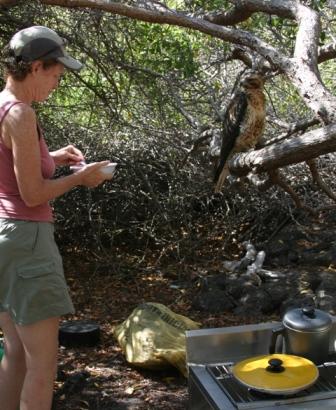
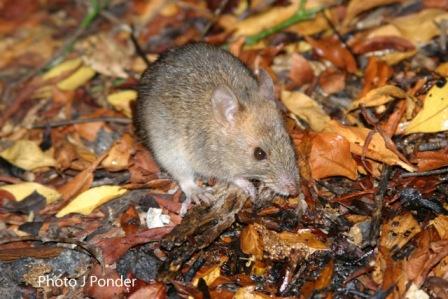
Thought I might share some images of other visitors who have arrived in camp. We never know who is showing up on any given day. Have had sea lions, pelicans, short-eared owls and local Galapagos hawks show up frequently (field camp is not on an island undergoing rodent eradication). Note the picture where a large female hawk is perched in the middle of our “kitchen” area – hard to keep 10 meters away from the wildlife when it shows up in the kitchen! Ironically, one of our visitors was a rare endemic rice rat – a species thought to be extinct for over 100 years in Galapagos and found in the late 1990’s on Santiago. Very cute and not destructive like the black rats and ship rats driving the eradication program. As a critically endangered endemic species, the rice rat gets excellent protection.

The bait drops for the rodent eradication went extremely well – two drops a week apart. The helicopter pilot was almost surgical in his precision. With that part done, we watch and wait. Watch/monitor what is happening on the islands (for 2 years!) and wait to release the hawks (just a few more weeks!).